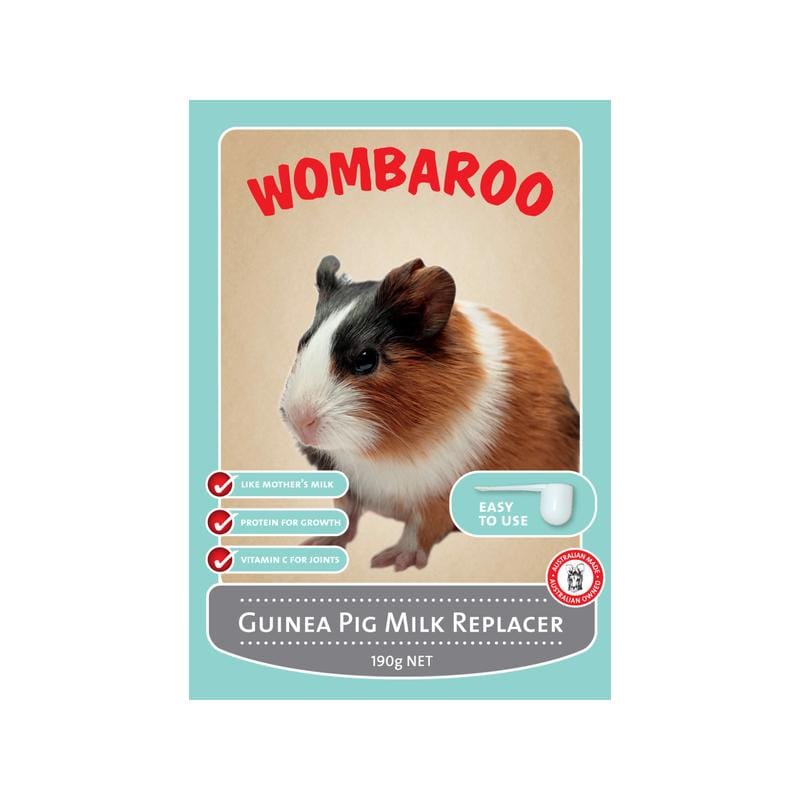
Wombaroo Guinea Pig Milk Replacer – Formula for Pups (190g)
A milk formula for orphaned or hand-reared guinea pig pups, enriched with the stabilised vitamin C they cannot make themselves.
Wombaroo Guinea Pig Milk Replacer is a powdered formula designed to replicate natural guinea pig milk, for orphaned pups, large litters, or where the mother’s milk isn’t enough. It’s enriched with stabilised vitamin C — guinea pigs of every age are unable to synthesise vitamin C themselves, and newborns are no exception.
Features
- Formulated to replicate natural guinea pig milk
- Enriched with stabilised vitamin C
- High in protein to support rapid early growth
- Suitable for orphaned pups, large litters and supplementary feeding
Mixing instructions
To make 1L: mix 190g of powder with 850mL of warm water. For a small batch of 105mL: mix 20g of powder with 90mL of water. Add half the water to the powder to form a paste, then add the rest and stir well. Water should be pre-boiled and cooled to about 35°C. Mixed milk keeps in the fridge for up to one day, or frozen in portions for up to two weeks.
Feeding guide
Feed every 2–3 hours for the first 5 days, then every 4 hours. Use a syringe or a Wombaroo P teat. Stimulate the pup to urinate and defecate after each feed. Begin introducing solids from day 2–3, and wean gradually by 14–21 days.
Good to know: guinea pig pups are not baby rabbits
This surprises people who’ve reared other small animals. Guinea pigs are born remarkably well developed — fully furred, eyes open, up and moving almost straight away — and they start nibbling solid food within a couple of days. That’s why the guide has you introducing solids from day 2–3 and weaning inside three weeks, a far shorter run than a rabbit kit. Get hay and greens in front of them early. And as with any hand-rearing, involve a vet or an experienced rescue early rather than late; the formula is one part of a job with very little margin for error.
Common questions
How often do I feed a newborn pup?
Every 2–3 hours for the first five days, then every four hours. It is genuinely intensive.
When can they start on solids?
From day 2–3 — much earlier than most people expect. Weaning is complete by 14–21 days.
Why does the formula need vitamin C?
Because guinea pigs can’t produce it. A milk replacer without it would leave a pup deficient at exactly the point it’s growing fastest.
See more guinea pig supplies.
| Weight | 0.22 kg |
|---|---|
| TYPE | 190g |
You may also like


Fido’s Friend